Michelangelo, St. Luke, and the World's Longest Portico
Saint Luke's Madonna, Painted by the Evanglist.
Bologna is world-renowned for its food, home to ragu, lasagne, and pink-hued mortadella. We arrived with the same culinary expectations as any traveler; however, we were surprised by the deep, spiritual connections here.
Our 1-day itinerary of faith begins with the image of the Madonna, painted by Saint Luke the Evangelist. Then the San Luca Bologna walk, with its 666 arches, to symbolically “crush the serpent” underfoot while leading us back into the city center. There we say a Rosary with St. Dominic before visiting two historic Basilicas. After a delicious lunch, of course, ragù alla bolognese and traditional lasagne verde, we visited the tomb of a fascinating and blessed young girl.
The Longest Portico: How to Walk to San Luca Bologna
Bologna’s pilgrimage to Our Lady of Saint Luke (Santuario Madonna di San Luca) is truly unique. Unique in that it’s a walk under a covered portico, in fact the world’s longest portico. This portico is built with 666 numbered arches, and winds like a snake. The final arch is located at the entrance to Our Lady’s Sanctuary, who is symbolically standing on top of the devil beneath her feet. Completing this hike to see the icon of the Madonna is like crushing the serpent yourself.
The walk begins at Porta Saragozza, one of the ancient gates of the old city wall, and continues for 2.5 miles (3.8 Km). Once you hit Arco del Meloncello, the first numbered arch, the path turns uphill, raising about 700 feet. This is also where the shade begins. (An alternative is to start at the Sanctuary and walk down the hill. We cover that option later in this post)
Porta Saragozza, where the San Luca Bologna Walk Begins.
Arco Bonaccorsi - Start of the San Luca Bologna Walk.
Madonna and Child fresco found under the arches.
Several of the 666 Arches in Bologna.
The covered walkway was built between 1674 and 1793 to protect the annual procession of the Madonna from the unpredictable weather. This procession, which brings the Icon to the Cathedral of San Pietro, marks the event in 1433 when the Icon was said to have stopped the incessant rains that threatened the region’s crops. The procession takes place on the week of the Ascension (May 9th in 2026).
As we walked, counting the arches of course, we periodically paused to enjoy the frescos that dot the path. The frescos depict the 15 mysteries of the Rosary. These frescos are more akin to St. Dominic’s Rosary, pre-dating the institution of the Luminous Mysteries.
This fresco shows the Descent of the Holy Spirit.
Descent of the Holy Spirit.
Sanctuary of San Luca: On Top of Bologna
The Sanctuary of San Luca at the top of the walk.
The Sanctuary of San Luca finally emerges as a warm, terracotta-hued sentinel overlooking the valley. The current Baroque basilica, designed by Carlo Francesco Dotti in the 18th century, serves as a grand reliquary for the city’s most precious treasure: the Madonna di San Luca. This Byzantine icon, a beautiful “Black Madonna,” arrived on this hilltop in the 12th century, though tradition holds that it was originally “written” by St. Luke the Evangelist himself.
St. Luke is said to have been a physician by trade, and an artist, in addition to writing the Gospel of St. Luke. St. Paul and he were close friends and traveling companions. While there, I was struck by the possibility that St. Luke actually met Mary, or at least knew people who knew her. The legend holds that he painted the Icon. Imagine, someone who possibly saw her, painted her image for posterity.
The icon as displayed in the Sanctuary is encased with silver to protect it, showing just the faces.
The Madonna of San Luca.
We did not continue to the top of the dome, but I can imagine the view of Bologna is amazing from there.
Basilica di San Domenico—The Birthplace of the Rosary
Turning south from the bustling center of Bologna, we found ourselves in the quiet, pebble-paved Piazza San Domenico. Here lies the tomb of Saint Dominic of Guzmán, the founder of the Dominican Order. Dominic died here in 1221, and construction on the current basilica began almost immediately to house his remains.
The Basilica di San Domenico (Saint Dominic) in Bologna.
The Arca di San Domenico
The focal point of our visit was the Arca di San Domenico, the saint’s marble tomb located in a side chapel, under a magnificent dome. Sitting in Dominics’s chapel, in front of his tomb, seemed like a very fitting place to say the Rosary. Afterwards, we had a chance to venerate his remains with the window on the back side of the tomb. Laura’s niece is a sister with the Dominican Sisters of Mary, Mother of the Eucharist, so we bought several prayer cards and touched them to the tomb, a gift for the sisters.
The Tomb of Saint Dominic.
Later, we learned that part of the tomb was carved by a then-unknown sculptor named Michelangelo. He carved the angel on the right side, plus the figure of San Proculo, who looks like he could have been a model for the David.
Dome in the Saint Dominic Chapel. The Glory of Saint Dominic.
San Proculo by Michelangelo.
The Rosary: Tradition and Devotion
The most enduring legacy of Saint Dominic is the Holy Rosary. According to tradition, the Virgin Mary appeared to Saint Dominic in 1214 and presented him with the Rosary to aid in his struggle against heresy. While modern historians view the Rosary’s development as a more gradual evolution involving many medieval strands, the “Dominican Rosary” remains one of the standard forms, along with the “Common Rosary,” used by Catholics worldwide today. An order of Dominican Friars explain slight difference between the two types here.
Inside the Basilica, the Chapel of the Rosary is a breathtaking testament to this devotion. The walls are adorned with the “Mysteries of the Rosary,” painted by various Bolognese masters.
Altar in The Rosary Chapel, showing the 15 mysteries.
The Rosary Chapel.
The Cathedrals of San Pietro and San Petronio
We headed back to the main piazza of Bologna (Piazza Maggiore) to see the Basilica di San Petronio, the patron saint of Bologna. The Basilica dominates the Piazza Maggiore and is considered the largest brick church in the world. Its unfinished facade—half-sheathed in marble and half-exposed brick—comes from the time when Bologna’s architectural ambition was halted by papal decree, lest it outshine St. Peter’s Basilica in Rome.
Cassini Meridian Line in the Basilica di San Petronio.
Inside, the Cassini Meridian Line stretches 220 feet (67 meters) across the floor; a single dot of sunlight tracks the time and enabled Cassini to deeply understand the orbit of Earth around the Sun. Another collaboration between science and the Church.
A short walk to the north, through the high-end shops of Via dell’Indipendenza lies the Cathedral of San Pietro. This is city’s true “mother church” and the seat of the Archbishop; it is here that the Madonna di San Luca resides during her annual May procession. The largest bell in the tower is nicknamed “La Nonna” (Grandmother in Italian). Tours are available to climb up to see La Nonna, though it takes a team of 23 to ring it, so that doesn’t happen very often.
Cathedral of San Pietro.
La Grassa—Nourishing the Pilgrim Body
Pilgrimage nourishes the soul, but we also need fuel for our bodies. Eating has become an important part of our pilgrimages–enjoying the local cuisine allows us to immerse ourselves into the culture of a city. Many would argue that there is no better city for food than “La Grassa”, or “The Fat One”, the nickname that Bolongna earned over many generations. The heart of Bologna’s food culture is the Quadrilatero, a maze of narrow streets where food has been traded since the Middle Ages.
Walking through the Via Pescherie Vecchie, we were overwhelmed by the options. Everywhere you looked, a salumeria here, an osteria there, and the most difficult decision of the day was where to grab a table. We spotted an open one, and a friendly face, at 051 Osteria Zerocinquantello.
Traditional lasagne verde with spinach pasta.
Tagliatelle with ragù alla bolognese.
The authentic tagliatelle with ragù alla bolognese and traditional lasagne verde were fantastic, and exactly what we need to fuel the rest of the day. I had been looking forward to this day ever since we placed Bologna on our travel itinerary. However, to be honest, the food was really good, but was not unique. We’ve had excellent bolognese sauce and lasagne throughout Italy, and even in America.
The cuisine of Bologna is so good that the world has found it, and copied it. I’m really glad that we were able to discover the faithful riches of Bologna as well.
The Little Flower of the Eucharist: Blessed Imelda Lambertini
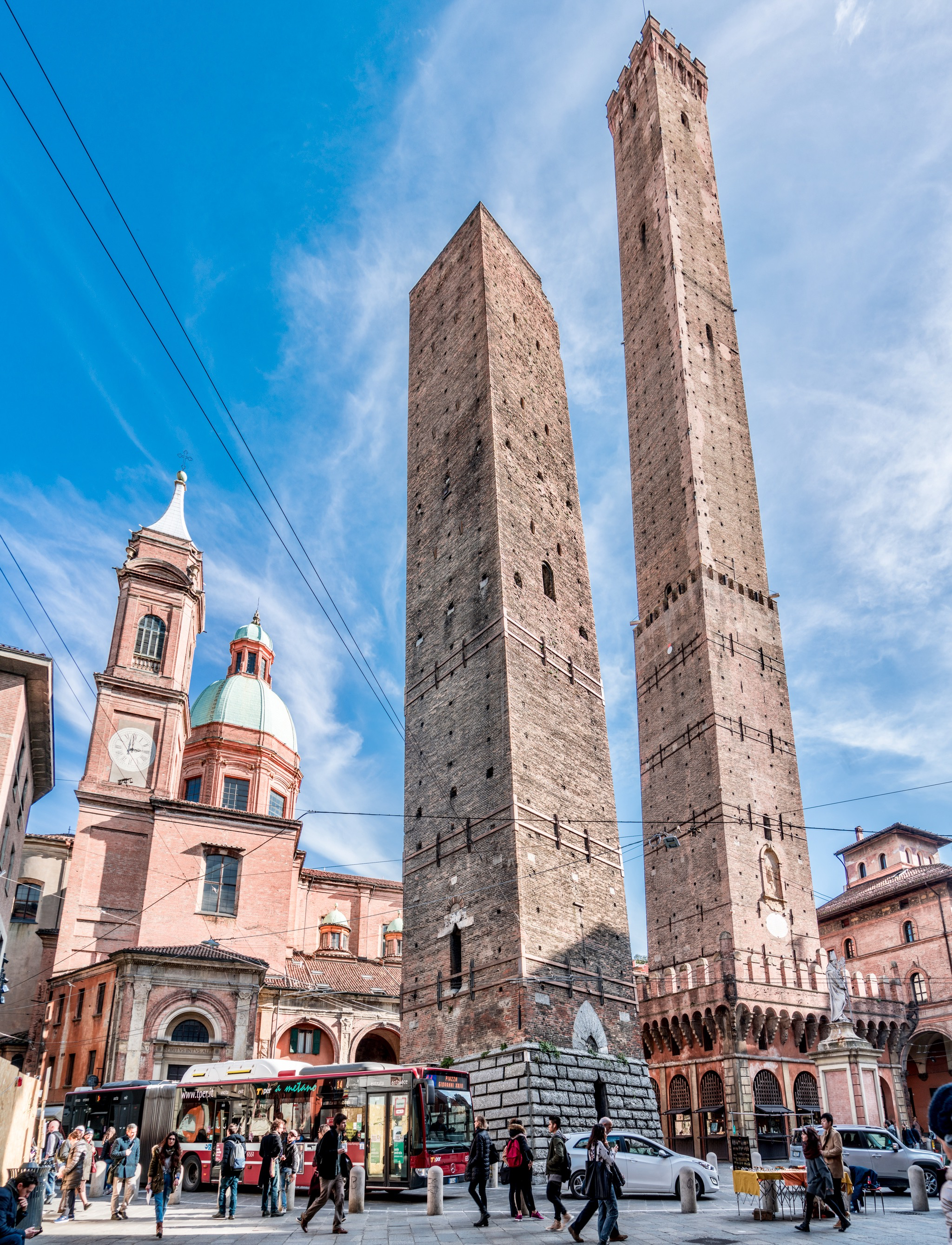
A post-lunch walk through the Two Towers (of Bologna) brought us to the church of San Sigismondo, final resting place of Blessed Imelda Lambertini. She is the Protectress of First Holy Communicants because of her devotion to and desire for the Holy Eucharist. Observing the causal approach to the Eucharist by many people, she is known to have said, “Tell me, can anyone receive Jesus into his heart and not die?”
Two Towers of Bologna: Asinelli and Garisenda.
Her deep desire to receive communion led to her parents allowing her to enter the Dominican convent at the extraordinarily young age of nine. She worked and prayed with the sisters but her desire to receive the Eucharist was denied; at the time people did not have a First Communion until the age of fourteen. She was relentless in asking for permission, which came on the Feast of the Ascension. After the other sisters received communion, the priest noticed little Imelda praying, with a glow above her head – it was the Sacred Host illuminated in that glow.
The priest gave her the First Holy Communion and she sat in prayer with a smile. Later that day, the prioress noted the absence of Imelda and went to the chapel to find her still there, having died from pure joy.
The wax effigy of Blessed Imelda Lambertini is located on the right side of the church, in a glass reliquary.This is well worth the walk.
Visiting the University of Bologna
San Sigismondo is adjacent to the historic University of Bologna, the world’s first University. By establishing the first self-governing guild of students and masters, it created a model for every university that followed. Its halls have been occupied by legendary figures who navigated the boundaries of faith, law, and science:
Dante Alighieri & Petrarch: The twin pillars of Italian literature who refined their poetic and humanistic voices within these medieval walls.
Saint Thomas Becket (12th century): Before his famous conflict with King Henry II of England, the future Archbishop of Canterbury studied canon law in Bologna, a training that undoubtedly informed his firm stance on the rights of the Church.
Nicolaus Copernicus: The astronomer who studied canon law here (around 1496) before famously shifting the center of the solar system.
Laura Bassi: A pioneer of the Enlightenment; she became the first woman in the world to be earned a university chair in a scientific field—specifically physics—in 1732.
Long-Distance Radio: Although Guglielmo Marconi was not a formal graduate, he attended lectures at the university and conducted his early, groundbreaking experiments in wireless telegraphy.
Luigi Galvani: The anatomy professor whose observations on “animal electricity” in the university’s laboratories provided the foundational spark for modern neurobiology.
Essential Sights for the University of Bologna
Exploring the university today feels less like visiting a modern campus and more like wandering through a living archive of human achievement. Here are key landmarks that are essential for any visitor:
The Archiginnasio & Anatomical Theatre: A 17th-century masterpiece carved entirely from spruce wood; it features the “Spellati” statues—hauntingly detailed wooden figures of skinned men—flanking the professor’s chair.
Palazzo Poggi: A grand 16th-century palace housing extraordinary collections of anatomical waxes, ancient naval models, and early astronomical instruments.
The Tombs of the Glossators: These unique, elevated stone monuments in the city’s squares house the remains of the 13th-century law professors who painstakingly annotated Roman law for the modern world.
The Heraldic Complex: Located within the Archiginnasio, this is the world’s largest collection of coats of arms (over 6,000 shields), honoring the international students who traveled across the continent to study in Bologna.
The Marconi Museum: Located at Villa Griffone just outside the city, marks the birthplace of wireless communication where Guglielmo Marconi sent the first long-distance radio signal in 1895.
A Walking Guide to Bologna - Pilgrimage Style
To truly appreciate Bologna, we recommend following the traditional path of the icon—starting from the heights of the Colle della Guardia and descending into the lively university district. This 4-mile (6.5 Km) journey allows you to experience everything in this post, in a faith-filled day.
This 1-day itinerary for a Pilgrimage throughout Bologna started with a taxi ride to the Sanctuary. The San Luca Express is a tourist tram along the portico and stops at the top.
Sanctuary of the Madonna di San Luca: The starting point atop the hill, home to the Byzantine icon and the sweeping views of the Emilian countryside. The main attraction is the Icon. Optionally, you can climb to the top of the dome (tickets available inside). As you step out, the first arch (not visually numbered) is 666.
The 666 Arches: The descent through the world’s longest portico, where you symbolically walk the coils of the serpent toward the city gates. Along the way, you will see the niches with the 15 mysteries of the Rosary. (2.2 miles, 3.5 Km)
Porta Saragozza: The medieval “Gate of the Pilgrims” that marks your entry back into the historic city walls. Shortly after the gate, we stopped for a bite at The Corner Bar. A nice place for a caffè con cornetto, or a mortadella sandwich with an Aperol Spritz if it’s later in the day.
Basilica di San Domenico: A short walk south to visit the tomb of St. Dominic, the Rosary Chapel, and the early works of Michelangelo. (0.75 miles, 1.2 Km)
Basilica di San Petronio: The heart of Piazza Maggiore, featuring the world’s longest indoor sundial.(0.3 miles, 0.5 Km)
Cathedral of San Pietro: The Archbishop’s seat on Via dell’Indipendenza and the urban home of the Madonna during her May “visit.” (0.25 miles, 0.3 Km)
TheQuadrilatero: The food market district, perfect place to absorb the scents and flavors of Bologna, and a hearty lunch. (0.3 miles, 0.5 Km)
San Sigismondo: The final resting place of Blessed Imelda Lambertini. (0.6 miles, 1 Km)
The Archiginnasio & University District: The final stop, where the Anatomical Theatre and the heraldic shields of the world’s oldest university celebrate the legacy of La Dotta.
We created this Walking Map for the 1-day Bologna Pilgrimage.
Walking Map of Bologna - Note: for illustration only, not for navigation.
Frequently Asked Questions
How long does it take to walk the portico to the Sanctuary of San Luca? It is 2.4 miles (3.5 Km), so it can be completed in an hour, depending on how many rest stops, which we call photo opportunities.
Why are there exactly 666 arches in the San Luca portico? The 666 number is called the “mark of the beast”, a representation of the devil (or serpent). In many depictions of Mary, she is shown standing on top a serpent. So, the portico is a large symbol of the Virgin Mary defeating the devil.
Is the Madonna di San Luca icon really painted by Saint Luke the Evangelist? Tradition holds that it was Saint Luke (San Luca) who painted this icon, but some scientists date it to the 12th century.
When does the annual procession of the Madonna take place in 2026? In 2026, the icon is scheduled to descend from her sanctuary on Saturday, May 9, and will remain at the Cathedral of San Pietro for a week of veneration.
Where can I find the early works of Michelangelo in Bologna? You can find Michelangelo’s early sculptures within the Basilica di San Domenico, specifically on the Arca di San Domenico (the saint’s tomb). At the age of twenty, he carved three figures for the shrine: a sturdy angel holding a candelabrum, Saint Proculus, and Saint Petronius.
Is the Rosary really connected to Saint Dominic and this Basilica? According to a long-standing tradition, the Virgin Mary appeared to Saint Dominic in 1214 and presented him with the Rosary as a spiritual tool for his mission. While the prayer’s development was a gradual historical process, the Dominican order has been instrumental for incorporating the Rosary into our daily prayers.
Can you visit the Anatomical Theatre at the University of Bologna? Yes, the Anatomical Theatre is located within the Archiginnasio Palace and is open to the public for a small entrance fee (approximately €3). This 17th-century lecture hall is carved entirely from spruce wood and features the “Spellati”—statues of skinned men—flanking the professor’s chair.
Why is traditional Bolognese lasagna green? Authentic Lasagna Verde alla Bolognese gets its signature green color from spinach incorporated directly into the fresh egg pasta dough.
Is there an entrance fee for the main basilicas and the university sites? Most major churches in Bologna, including the Cathedral and the Basilica of San Domenico, offer free entry for prayer and general visiting. However, specific areas—such as the Anatomical Theatre, the museum at San Petronio, or the panoramic terrace at San Luca—usually require a small fee (typically €3 to €5) to support maintenance and preservation.
What is the “Miracle of the Rain” and why is it significant to the city? The miracle occurred in July 1433 when a period of relentless, devastating rain threatened to destroy the region’s food supply. The citizens brought the icon of the Madonna di San Luca down into the city in a desperate procession, and the rain reportedly stopped the moment the icon entered the city gates. This event cemented the icon’s role as the “Protector of Bologna” and established the tradition of the annual May procession.
How difficult is the climb from the Meloncello Arch to the summit? The climb after the Meloncello Arch is significantly more difficult than the first half of the walk, with an average gradient of 10% and sections reaching up to 20%. You will climb roughly 215 meters (over 700 feet) in a relatively short distance.
Who was Blessed Imelda Lambertini and where is her shrine? Blessed Imelda Lambertini was a 14th-century Dominican novice who is the patroness of First Holy Communicants. Her shrine is located in the Church of San Sigismondo. She is remembered for her intense devotion to the Eucharist and her miraculous death at the age of eleven immediately after her first communion.
Is Imelda Lambertini a Saint? Technically, she is a “Blessed,” which is the final step before formal canonization. Her public cultus (devotion) was formally approved by Pope Leo XII in 1826, and she was later named the Protectress of First Communicants by Pope Pius X.
Is Blessed Imelda Lambertini’s body incorrupt? No. She is frequently listed among the incorruptible saints, though when you visit her shrine, you are looking at a life-like wax effigy. This sculpture houses her actual remains and depicts her in a state of peaceful rest. This practice is common in Italian pilgrimage sites, providing a visual window into the saint’s life while protecting the relics within.
What is Blessed Imelda Lambertini’s famous quote? She is famously remembered for her profound question to the sisters of her convent: “Tell me, can anyone receive Jesus into his heart and not die?”
Things To Do In Bologna
If you are staying longer in Bologna and want to have some other experiences, here are a few that we’ve selected:




Pingback: A Southern Italy Pilgrimage: From Padre Pio to the Sassi of Matera {#2 in the series} - The Hallowed Way